
01
Strategy
Examines whether people understand the organization's direction, whether plans connect to that direction, and whether the organization can adapt as conditions change.
VisionPlanningFlexibility
PAG's research platform combines a proprietary organizational-health assessment with targeted qualitative inquiry to create an objective picture of organizational alignment, strengths, gaps and readiness for change.
The OHS™ is PAG's proprietary organizational-health survey, designed to measure how effectively the conditions that drive performance are understood, aligned and reinforced across the enterprise.
Unlike a narrow engagement or satisfaction survey, OHS examines the broader organizational system. It looks at how people experience Strategy, Culture, Talent and Information—and whether those elements are working together in ways that support clarity, alignment and execution.
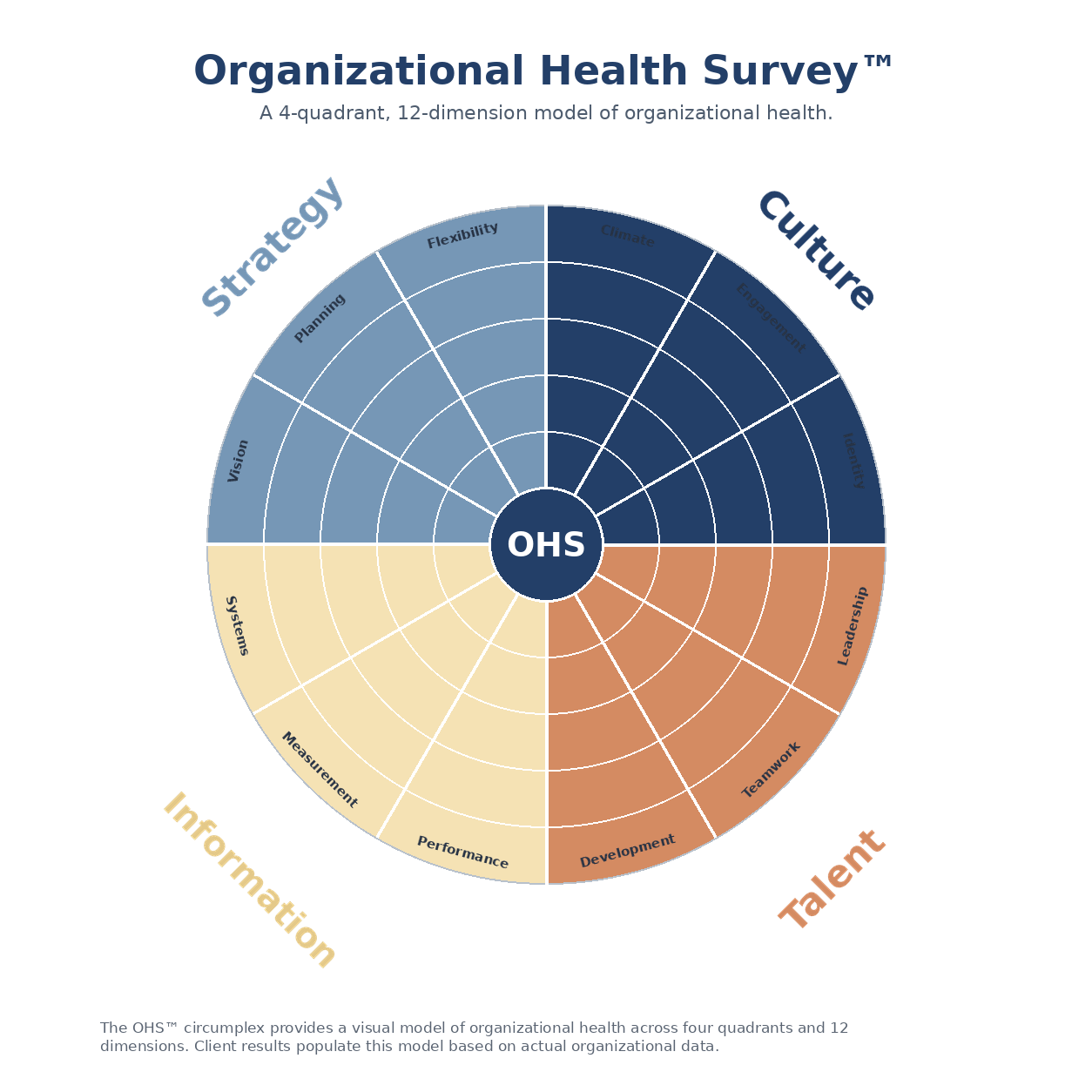
The OHS™ circumplex provides a visual model of organizational health across four quadrants and 12 dimensions. Client results populate this model based on actual organizational data.
Each quadrant represents a critical organizational condition. Three dimensions within each quadrant provide the deeper diagnostic view.
Examines whether people understand the organization's direction, whether plans connect to that direction, and whether the organization can adapt as conditions change.
Examines the degree of trust, openness, pride, purpose and shared identity that shape the everyday employee experience and support performance.
Examines leadership effectiveness, teamwork and the organization's ability to develop the capabilities people need to perform and grow.
Examines whether systems, measures and performance information give people what they need to make decisions, improve and execute effectively.
Enterprise-wide quantitative assessment across the 4 quadrants, 12 dimensions and 60 items of the OHS model.
One-on-one conversations with selected executives, leaders and employees add context, examples and perspectives that numbers alone cannot provide.
PAG can convert the 12 OHS dimensions into a structured qualitative interview framework to examine readiness, barriers and opportunities for change.
Results can be examined across meaningful populations—such as role, level, tenure, location or other client-defined groups—to reveal important differences in experience and alignment.
Open-ended questions and interview themes help surface the language, examples and recurring issues behind the quantitative findings.
PAG synthesizes the quantitative and qualitative evidence into strengths, gaps, cross-cutting themes, priorities and recommendations for leadership action.
The research is translated into a usable picture of the organization—designed to support leadership discussion, prioritization and action.
A visual profile of organizational health across all 12 dimensions.
Clear views of Strategy, Culture, Talent and Information, with the three dimensions underlying each.
Visibility into the specific issues contributing to dimension strengths and opportunities.
Meaningful differences across selected employee populations and organizational segments.
Recurring perspectives, examples and issues surfaced through open-ended responses and interviews.
An integrated interpretation of the evidence, with priorities and recommendations designed for action.
The findings can stand alone as an organizational diagnostic or directly inform PAG's work in Culture, Leadership Development, Executive Coaching and AI Fluency.